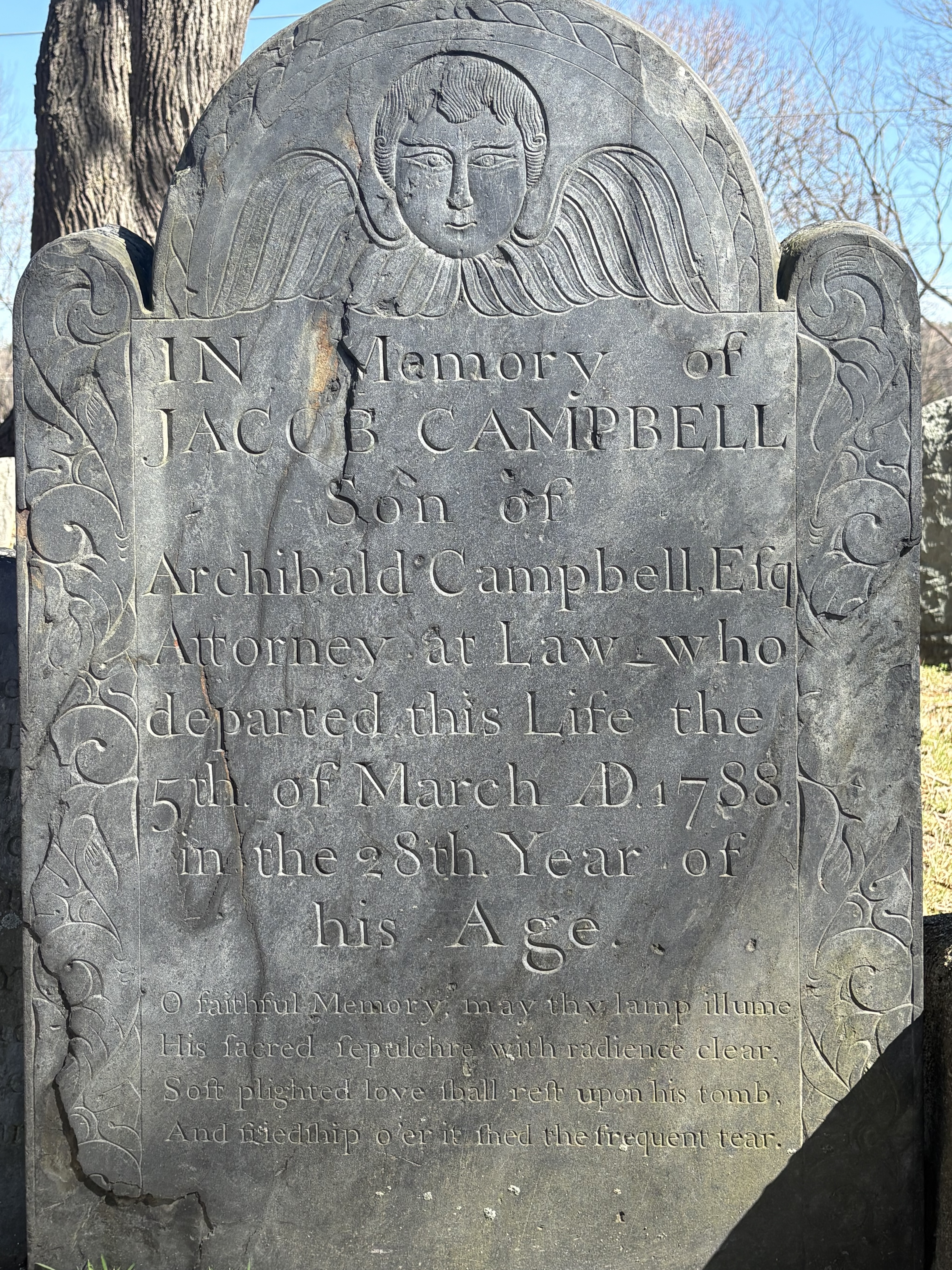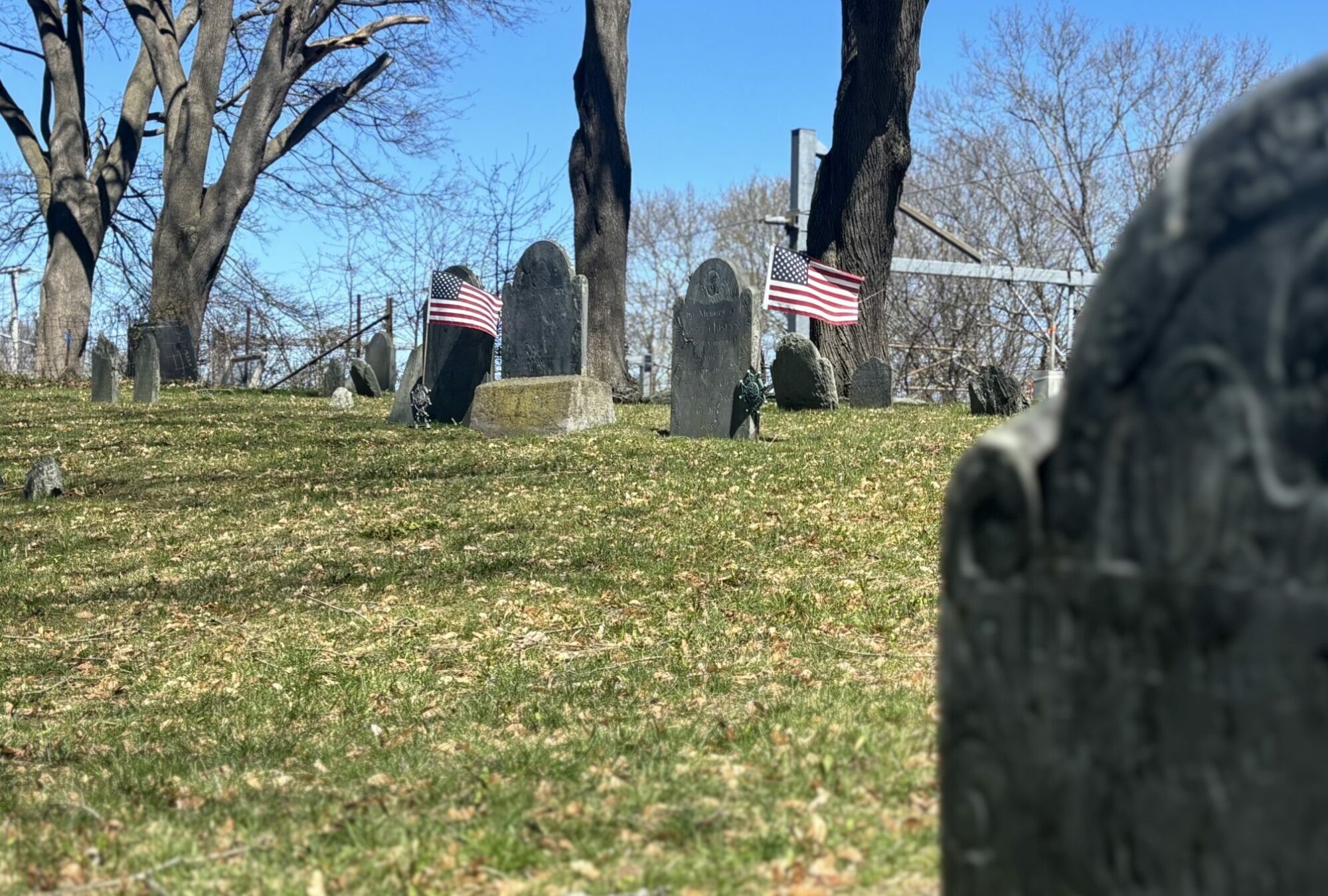

Jacob Archibald Campbell (grave 17) was baptized by the Rev. Ezra Stiles in Newport on December 28, 1760. Jacob’s mother was Hope (Brown) Campbell, and his father, Archibald Campbell (18) was the first attorney in East Greenwich.
Jacob was a boy of eight when his father died and not quite twenty when his stepfather died. Despite these losses, he was clearly a young man of considerable promise. Physically, he was “tall, slender and gentle, had a beautiful head of hair, and reputed one of the handsomest men of the day.”
Jacob Campbell was serving with the Rhode Island militia as early as 1777, at the age of 16 years old – the age at which militia duty was compulsory for all men in the Colonies at the time. On October 9, 1777, an equipment inventory of Captain William Arnold’s Company in Colonel Richard Fry’s Regiment listed a Jacob Campbell as in possession of one gun, one bayonet, one cartouche box, 24 cartridges and two flints. Colonel Richard Fry commanded the Kentish Guards of East Greenwich and was also placed in command of other militia companies to form a regiment for periods of time. At the time of that equipment inventory, Captain Arnold’s Company was in camp with Colonel Fry’s Regiment at Warren, Rhode Island. This encampment was part of what became known as “Spencer’s Expedition” – a secret operation for some ten thousand troops to attack the British on Aquidneck Island by boat. Amid delays and foul weather, the expedition lost the element of surprise and did not succeed.
Jacob was listed again in service for 29 days, from December 9, 1777, to January 7, 1778, as a private under Sergeant Andrew Boyd at East Greenwich, and then for another 30 days in the same unit, from January 8, 1778 to February 7, 1778. He appeared on one more pay roll for 30 days, from February 7, 1778, to March 8, 1778, as part of 12 militia who did guard duty on the East Greenwich waterfront that month.
Later that year, Jacob served for 20 days in the “Expedition on Rhode Island” according to East Greenwich Council records dated August 6, 1778. The following year, on June 2, 1779, in East Greenwich, Jacob signed a receipt for pay for his service in the “expedition against Newport in August and September” of the previous year. This expedition culminated in the Battle of Rhode Island.

NB: There was another Jacob Campbell (1762-1845) born in Voluntown, Connecticut, who also served as a soldier in Rhode Island. According to affidavits filed as part of his pension application, this Jacob Campbell served two one-year enlistments with Captain Philip Traffan’s Company in Colonel John Topham’s Rhode Island Regiment, and served a third enlistment with Captain Potter’s Company in Colonel Christopher Greene’s Regiment. This Jacob also served at the Battle of Rhode Island, eventually received a pension for his service, and settled in New York after the war.
In 1783, our Jacob graduated from Rhode Island College, which later became Brown University. A published poet, he first taught a classical school in town, which would have included subjects like logic, rhetoric, and Latin or Greek. He then followed in his father’s footsteps and was admitted to the bar at the October 1785 term of the Superior Court in East Greenwich. He opened a law office in East Greenwich.
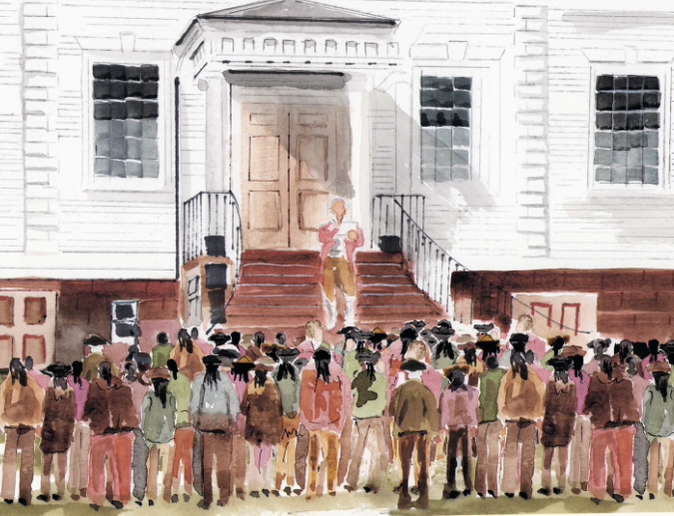
In September 1783, Jacob was selected to read the Treaty of Paris to the townsfolk of East Greenwich from the steps of Courthouse, where today’s Town Hall stands. After the reading, Jacob added his own remarks: “…You have suffered the vicissitudes of war, borne its fatigues, braved its dangers, have fought, bled and conquered. Through every stage of its progress, East Greenwich has stood unrivalled. When we consider the early and decisive part she took, the unanimity and exertions of her inhabitants, the number and abilities of her officers, we shall conceive her entitled to a splendid page in the annals of the Revolution.”
Jacob died a young man and left no children. He was engaged to Eliza Russell when he was taken ill with consumption. Eliza, a young woman from a wealthy Providence family, nursed Jacob to the end. She had the stone above his grave erected and inscribed with this touching poem:
“Oh faithful memory may thy lamp illume
The sacred sepulchre with radiance clear,
Soft plighted love shall rest upon his tomb,
And friendship o’er it shed the fragrant tear.”
Brokenhearted, she reportedly retired to a darkened room where she stayed the rest of her life. “Only those who could talk about him were admitted to her presence, and the sickness, suffering and death of Campbell were the only topics on which she would speak.” Eliza died on December 3, 1796.